24 Aralık 2018 Pazartesi

Business Ethics - A Successful way of conducting business

Definition of Business Ethics

Business Ethics refers to carrying business as per self-acknowledged moral standards. It is actually a structure of moral principles and code of conduct applicable to a business. Business ethics are applicable not only to the manner the business relates to a customer but also to the society at large. It is the worth of right and wrong things from business point of view.
Business ethics not only talk about the code of conduct at workplace but also with the clients and associates. Companies which present factual information, respect everyone and thoroughly adhere to the rules and regulations are renowned for high ethical standards. Business ethics implies conducting business in a manner beneficial to the societal as well as business interests.
Every strategic decision has a moral consequence. The main aim of business ethics is to provide people with the means for dealing with the moral complications. Ethical decisions in a business have implications such as satisfied work force, high sales, low regulation cost, more customers and high goodwill.
Some of ethical issues for business are relation of employees and employers, interaction between organization and customers, interaction between organization and shareholders, work environment, environmental issues, bribes, employees rights protection, product safety etc.
Below is a list of some significant ethical principles to be followed for a successful business-
  1. Protect the basic rights of the employees/workers.
  2. Follow health, safety and environmental standards.
  3. Continuously improvise the products, operations and production facilities to optimize the resource consumption
  4. Do not replicate the packaging style so as to mislead the consumers.
  5. Indulge in truthful and reliable advertising.
  6. Strictly adhere to the product safety standards.
  7. Accept new ideas. Encourage feedback from both employees as well as customers.
  8. Present factual information. Maintain accurate and true business records.
  9. Treat everyone (employees, partners and customers) with respect and integrity.
  10. The mission and vision of the company should be very clear to it.
  11. Do not get engaged in business relationships that lead to conflicts of interest. Discourage black marketing, corruption and hoarding.
  12. Meet all the commitments and obligations timely.
  13. Encourage free and open competition. Do not ruin competitors’ image by fraudulent practices.
  14. The policies and procedures of the Company should be updated regularly.
  15. Maintain confidentiality of personal data and proprietary records held by the company.
  16. Do not accept child labour, forced labour or any other human right abuses.

Porter’s Five Forces Model of Competition

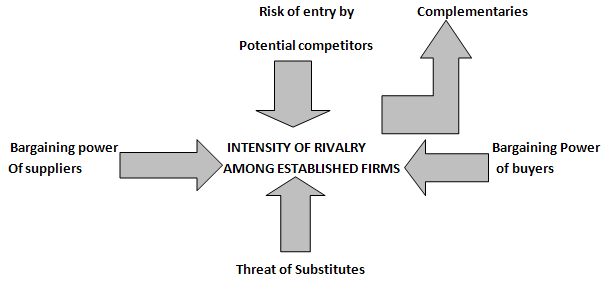
Michael Porter (Harvard Business School Management Researcher) designed various vital frameworks for developing an organization’s strategy. One of the most renowned among managers making strategic decisions is the five competitive forces model that determines industry structure. According to Porter, the nature of competition in any industry is personified in the following five forces:
  1. Threat of new potential entrants
  2. Threat of substitute product/services
  3. Bargaining power of suppliers
  4. Bargaining power of buyers
  5. Rivalry among current competitors
Porters Five Forces Model of Competition 
FIGURE: Porter’s Five Forces model
The five forces mentioned above are very significant from point of view of strategy formulation. The potential of these forces differs from industry to industry. These forces jointly determine the profitability of industry because they shape the prices which can be charged, the costs which can be borne, and the investment required to compete in the industry. Before making strategic decisions, the managers should use the five forces framework to determine the competitive structure of industry.
Let’s discuss the five factors of Porter’s model in detail:
  1. Risk of entry by potential competitors: Potential competitors refer to the firms which are not currently competing in the industry but have the potential to do so if given a choice. Entry of new players increases the industry capacity, begins a competition for market share and lowers the current costs. The threat of entry by potential competitors is partially a function of extent of barriers to entry. The various barriers to entry are-
    • Economies of scale
    • Brand loyalty
    • Government Regulation
    • Customer Switching Costs
    • Absolute Cost Advantage
    • Ease in distribution
    • Strong Capital base
  2. Rivalry among current competitors: Rivalry refers to the competitive struggle for market share between firms in an industry. Extreme rivalry among established firms poses a strong threat to profitability. The strength of rivalry among established firms within an industry is a function of following factors:
    • Extent of exit barriers
    • Amount of fixed cost
    • Competitive structure of industry
    • Presence of global customers
    • Absence of switching costs
    • Growth Rate of industry
    • Demand conditions
  3. Bargaining Power of Buyers: Buyers refer to the customers who finally consume the product or the firms who distribute the industry’s product to the final consumers. Bargaining power of buyers refer to the potential of buyers to bargain down the prices charged by the firms in the industry or to increase the firms cost in the industry by demanding better quality and service of product. Strong buyers can extract profits out of an industry by lowering the prices and increasing the costs. They purchase in large quantities. They have full information about the product and the market. They emphasize upon quality products. They pose credible threat of backward integration. In this way, they are regarded as a threat.
  4. Bargaining Power of Suppliers: Suppliers refer to the firms that provide inputs to the industry. Bargaining power of the suppliers refer to the potential of the suppliers to increase the prices of inputs( labour, raw materials, services, etc) or the costs of industry in other ways. Strong suppliers can extract profits out of an industry by increasing costs of firms in the industry. Suppliers products have a few substitutes. Strong suppliers’ products are unique. They have high switching cost. Their product is an important input to buyer’s product. They pose credible threat of forward integration. Buyers are not significant to strong suppliers. In this way, they are regarded as a threat.
  5. Threat of Substitute products: Substitute products refer to the products having ability of satisfying customers needs effectively. Substitutes pose a ceiling (upper limit) on the potential returns of an industry by putting a setting a limit on the price that firms can charge for their product in an industry. Lesser the number of close substitutes a product has, greater is the opportunity for the firms in industry to raise their product prices and earn greater profits (other things being equal).
The power of Porter’s five forces varies from industry to industry. Whatever be the industry, these five forces influence the profitability as they affect the prices, the costs, and the capital investment essential for survival and competition in industry. This five forces model also help in making strategic decisions as it is used by the managers to determine industry’s competitive structure.
Porter ignored, however, a sixth significant factor- complementaries. This term refers to the reliance that develops between the companies whose products work is in combination with each other. Strong complementors might have a strong positive effect on the industry. Also, the five forces model overlooks the role of innovation as well as the significance of individual firm differences. It presents a stagnant view of competition.

23 Aralık 2018 Pazar

SMART

What is SMART
SMART is an analytical technique for designing objectives in management and planning. SMART is an acronym from the initial letter of the English names of the objective attributes: Specific, Measurable, Achievable/Acceptable, Realistic/Relevant, Time specific/Trackable.


SMART is an analytical technique for designing objectives in managementand planningSMART is an acronym from the initial letter of the English names of the objective attributes:
  • S - Specific
  • M - Measurable
  • A - Achievable/Acceptable
  • R - Realistic/Relevant
  • T - Time Specific/Trackable
Use of the SMART method in practice: SMART method is used for the design of objectives (especially specific objectives). In their design it must be maintained the SMART condition for each objectives and their metricsIt means that each objective must be specific, measurable, achievable, realistic and time specified.

22 Aralık 2018 Cumartesi

Planning

What is Planning
Planning is one of key managerial functions and therefore applies to all fields and aspects of an organization: economics and finance, Informatics, quality management, human resources, logistics and transportation, organizational management, marketing, services, production.

Planning is one of the key managerial functions and therefore applies to all fields and aspects of an organization: Economy and FinanceInformaticsQualityHuman ResourcesLogistics and TransportationOrganizational managementMarketingServices, Production.
According to the period in which the planning takes place, one can distinguish between Strategic planning, Tactical planning and Operational planningForecasting deals with the prediction of a company´s long-term development.
Strategic planning is crucial for the long-term direction of an organization (business), for marketing, investment decision makinghuman resources development and research and development.
Tactical and operational planning plays a key role in organizational fields which are characterised by frequent fluxes of resources, namely financial resources and material in production process (purchase and sale).

Hierarchy of Strategies

What is Hierarchy of Strategies
Hierarchy of strategies describes a layout and relations of global strategy and sub-strategies of the organization.


Hierarchy of strategies describes a layout and relations of corporate strategy and sub-strategies of the organization. Individual strategies are arranged hierarchically and logically consistent at the level of visionmissiongoals and metrics.
Sometimes the designation logical framework of strategic planning and management is used.
Methods used in strategic planning: top-downbottom-up and bidirectional planning.
Hierarchy of Strategies of an organization may look like this;

Hierarchy of Strategies

Strategic Objectives (Strategic Goals)

What are Strategic Objectives (Strategic Goals)
Strategic Objective is a term denoting the highest goals of the organization or an individual. Strategic objectives are used in strategic management.


Strategic Objective (Strategic Goal) is a term denoting the highest goals of the organization or an individual. Strategic objectives are used in strategic management. Properly set strategic goals are not focused only on one metric of operation of the organization (for example, just to gain profit, but they are configured as balanced - (e.g. Balanced Scorecard).
The strategic objectives of the organization are linked to its mission and formulated vision. Strategic objectives may not necessarily meet the conditions and principles of SMART (specific, measurable, achievable, realistic and time availability), if they are further disintegrated into the specific objectives.
Use of strategic objectives in the organization: The strategic objectives of the organization are crucial to clarify its vision, which they concretize and specify. The strategic goals of the organization are generally defined by the owner or top management, who is also responsible for achieving them. Strategic objectives concretize the vision and help managers to manage and motivate staff at the organization.

20 Aralık 2018 Perşembe

Strategic Leadership - Definition and Qualities of a Strategic Leader

  Strategic leadership refers to a manager’s potential to express a strategic vision for the organization, or a part of the organization, and to motivate and persuade others to acquire that vision. Strategic leadership can also be defined as utilizing strategy in the management of employees. It is the potential to influence organizational members and to execute organizational change. Strategic leaders create organizational structure, allocate resources and express strategic vision. Strategic leaders work in an ambiguous environment on very difficult issues that influence and are influenced by occasions and organizations external to their own.
The main objective of strategic leadership is strategic productivity. Another aim of strategic leadership is to develop an environment in which employees forecast the organization’s needs in context of their own job. Strategic leaders encourage the employees in an organization to follow their own ideas. Strategic leaders make greater use of reward and incentive system for encouraging productive and quality employees to show much better performance for their organization. Functional strategic leadership is about inventiveness, perception, and planning to assist an individual in realizing his objectives and goals.
Strategic leadership requires the potential to foresee and comprehend the work environment. It requires objectivity and potential to look at the broader picture.
  A few main traits / characteristics / features / qualities of effective strategic leaders that do lead to superior performance are as follows:
Loyalty- Powerful and effective leaders demonstrate their loyalty to their vision by their words and actions.
Keeping them updated- Efficient and effective leaders keep themselves updated about what is happening within their organization. They have various formal and informal sources of information in the organization.
Judicious use of power- Strategic leaders makes a very wise use of their power. They must play the power game skillfully and try to develop consent for their ideas rather than forcing their ideas upon others. They must push their ideas gradually.
Have wider perspective/outlook- Strategic leaders just don’t have skills in their narrow specialty but they have a little knowledge about a lot of things.
Motivation- Strategic leaders must have a zeal for work that goes beyond money and power and also they should have an inclination to achieve goals with energy and determination.
Compassion- Strategic leaders must understand the views and feelings of their subordinates, and make decisions after considering them.
Self-control- Strategic leaders must have the potential to control distracting/disturbing moods and desires, i.e., they must think before acting.
Social skills- Strategic leaders must be friendly and social.
Self-awareness- Strategic leaders must have the potential to understand their own moods and emotions, as well as their impact on others.
Readiness to delegate and authorize- Effective leaders are proficient at delegation. They are well aware of the fact that delegation will avoid overloading of responsibilities on the leaders. They also recognize the fact that authorizing the subordinates to make decisions will motivate them a lot.
Articulacy- Strong leaders are articulate enough to communicate the vision(vision of where the organization should head) to the organizational members in terms that boost those members.
Constancy/ Reliability- Strategic leaders constantly convey their vision until it becomes a component of organizational culture.
To conclude, Strategic leaders can create vision, express vision, passionately possess vision and persistently drive it to accomplishment.

Strategic Decisions - Definition and Characteristics

Strategic decisions are the decisions that are concerned with whole environment in which the firm operates, the entire resources and the pe...